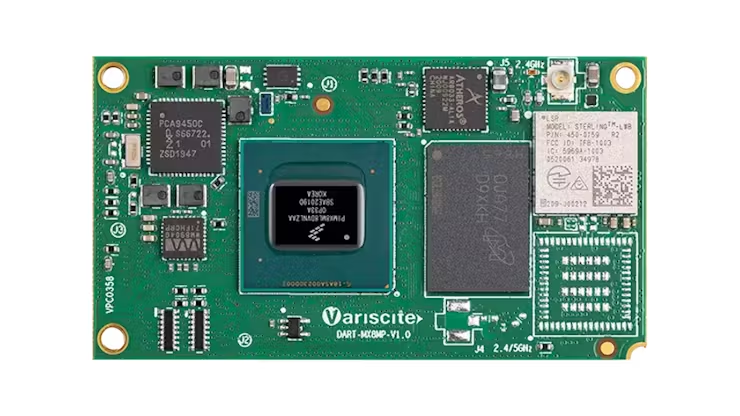
Building an Edge AI Product Family Around i.MX95 System‑on‑Modules
As edge AI matures, many industrial and commercial OEMs are no longer designing single, isolated devices; they are building entire product families that must share a common compute core while fitting radically different physical, thermal, and regulatory profiles. The challenge is to scale from proof‑of‑concept boards to field‑proven systems without fragmenting hardware and software into a maze of one‑off designs. System‑on‑modules based on NXP’s i.MX95 illustrate how a carefully planned ARM SoM portfolio can give teams both breadth and focus in this transition
At a high level, the i.MX95 SoM family uses the same underlying silicon platform to serve markets ranging from smart retail and medical devices to transportation and industrial automation. Each module benefits from the same combination of Arm Cortex‑A55 application cores, real‑time Cortex‑M7 and Cortex‑M33 microcontrollers, and a 2‑TOPS‑class NPU for vision and analytics workloads at the edge. Unified memory and storage options—LPDDR5 up to 16 GB and eMMC up to 128 GB—reduce the need to qualify multiple DRAM and flash configurations, which is often a hidden source of complexity in long‑life embedded projects
Where the portfolio becomes strategically interesting is the way it uses mechanical diversity to solve deployment‑specific problems without forking the compute platform. The SMARC module follows the SGET 2.1 specification, with an MXM connector that simplifies field replacement, upgrades, and variant management. This makes it attractive for products that need frequent updates or must support multiple SKUs with different connectivity mixes or performance tiers: connected kiosks, flexible gateways, and HMI panels that may add or drop features over time
The OSM module, by contrast, compresses the same computing resources into a solder‑down footprint optimized for rugged and space‑constrained systems. For applications where vibration, shock, and temperature cycling are daily realities—rolling stock, roadside infrastructure, compact fanless controllers—connector‑based modules can turn into long‑term reliability risks. A soldered module with industrial‑temperature operation, dual Gigabit Ethernet with TSN/AVB, and ample GPIO allows designers to build dense, mechanically robust boards that can run unattended for years
From an engineering‑management perspective, this dual‑form‑factor approach enables a more nuanced product‑roadmap conversation. Instead of treating every new device as a fresh hardware project, teams can plan around a stable i.MX95 compute baseline and decide, per product, whether modularity or ruggedization is the dominant concern. In early stages, SMARC‑based carrier boards can be used to explore I/O options, AI workloads, and HMI configurations; once requirements stabilize, the same software stack can migrate onto OSM‑based designs for environments where field‑swappable modules bring less value than mechanical simplicity
Connectivity and multimedia capabilities also influence system‑level architecture decisions. Because the i.MX95 SoMs expose PCIe, USB 3.x, MIPI‑CSI for cameras, and multi‑display interfaces, OEMs can distribute functions between the SoM and external accelerators or interfaces as needed, rather than over‑provisioning a monolithic CPU platform. For example, a smart retail terminal might prioritize high‑resolution displays and multiple network links, while an inspection node in a factory may allocate PCIe lanes and MIPI‑CSI bandwidth to multiple cameras with strict timing and synchronization requirements
The software layer is where the benefits of this consolidation are fully realized. Yocto‑based BSPs, pre‑verified drivers, and support for NXP’s eIQ machine‑learning environment mean that AI models, middleware, and security mechanisms can be qualified once and reused across SMARC and OSM designs. This is particularly important in regulated sectors such as healthcare or transportation, where software validation, penetration testing, and certification can dominate project timelines and budgets. Being able to move between prototypes, pilot deployments, and final rugged hardware without rewriting the software stack becomes a major strategic advantage
In practice, adopting an i.MX95 SoM portfolio is less about picking a single module and more about defining a family strategy: which products need serviceable compute modules, which require solder‑down robustness, and how far a single SoC generation can be stretched across different tiers of performance and cost. For organizations willing to design around that strategy, the payoff is a more coherent edge AI lineup—one where HMI panels, vision systems, and gateways share the same architectural DNA, and where future migrations to newer silicon can be planned as coordinated platform updates rather than a series of unrelated redesigns