How Does the Choice of Conference Room Furniture Affect the Functionality of Meeting Room Tables?
A meeting room table does more than provide a surface for discussions. Its dimensions, configuration, material composition, and integrated features influence how participants communicate, access information, and interact with one another. The selection of conference room furniture also affects how effectively a space accommodates different meeting formats, from small departmental discussions to larger presentations.
Leadcom Seating approaches workplace environments with an understanding of how furniture design contributes to practical meeting experiences, making spatial planning and functional requirements important considerations in office design.
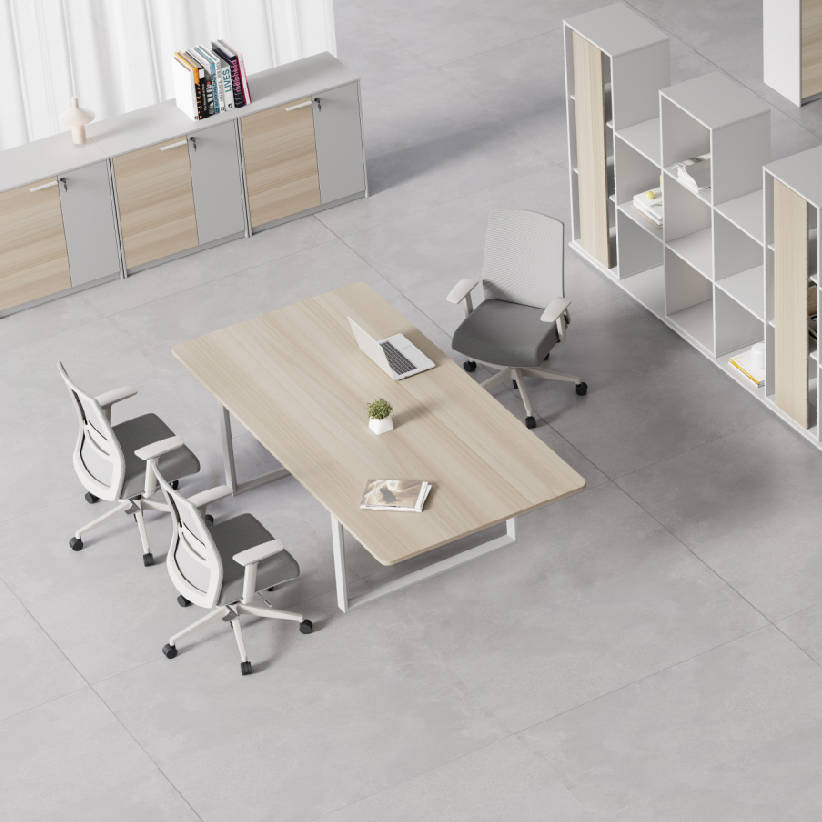
How Table Dimensions Shape Meeting Room Interaction
The relationship between table dimensions and room capacity deserves careful consideration. A table that occupies too much floor space can restrict chair movement and reduce circulation, while an undersized surface may leave participants without sufficient room for documents, laptops, and presentation materials. Appropriate proportions help maintain a comfortable distance between attendees and allow conversations to flow naturally.
Room geometry also influences the choice of table configuration. Rectangular designs generally suit formal discussions and presentation-oriented environments, whereas oval and round arrangements can create a more conversational atmosphere. Each layout affects sightlines, seating positions, and the ease with which participants address different sides of the room.
Beyond the tabletop itself, surrounding clearance plays an important role in usability. Participants need enough space to pull chairs backward, move between seats, and reach electrical connections without disturbing others. A carefully planned arrangement of conference room furniture considers these movement patterns rather than focusing exclusively on the number of available seats.
Material Selection and Structural Design in Meeting Spaces
The materials used in meeting tables influence their weight, surface characteristics, and suitability for different working environments. Particle board with a melamine finish, for example, offers a practical surface for everyday office activities. Its smooth exterior supports routine cleaning, while the underlying board provides a stable foundation for documents and electronic equipment.
Metal components contribute another dimension to furniture construction. Cold-rolled steel is frequently used in table legs and support structures because of its mechanical properties and suitability for fabricated frames. The dimensions and thickness of these components influence how the structure distributes weight across its supporting points.
The connection between the tabletop, legs, and under-desk beams also deserves attention. A properly designed support system helps limit unwanted movement when participants write, type, or adjust equipment. In shared meeting environments, structural stability is particularly relevant because several people may use the same surface simultaneously.
Cable Management and Technology Integration
Digital equipment has changed the way meeting tables function. Laptops, conferencing cameras, microphones, displays, and charging devices all require convenient access to power or connectivity. Without an organized cable arrangement, wires can accumulate across the tabletop and interfere with documents or presentation materials.
Integrated cable management provides a practical way to organize these connections. A built-in cable box, for instance, creates a designated location for managing excess wiring while keeping frequently used equipment accessible. Such features are particularly useful in rooms where participants regularly switch between individual computer work and group presentations.
Technology planning should also account for the position of electrical outlets and communication equipment. Tables intended for video conferences may require different connection arrangements from those used primarily for internal discussions. Well-considered conference room furniture accommodates these functional differences without making the working surface unnecessarily complicated.
A relevant example is the NOVA meeting table #30 from Leadcom Seating. Its tabletop uses E0-grade particle board with a melamine finish, while the legs feature 70 × 40 × 1.2 mm cold-rolled steel and the under-desk beam measures 38 × 38 × 1.2 mm. A built-in cable box provides an additional arrangement for managing workplace wiring, illustrating how surface materials, structural components, and practical accessories can work together within one table design.
Layout Flexibility and the Changing Needs of Meetings
Office meeting spaces rarely serve only one purpose. A room may host project reviews in the morning, client presentations in the afternoon, and training sessions later in the week. Furniture arrangements that accommodate these changing activities can make better use of available floor space.
Modular layouts offer one approach to this challenge. Individual tables can be arranged in rows for presentations, grouped into smaller clusters for collaborative tasks, or positioned in a U-shape for instructor-led sessions. The suitability of each arrangement depends on room dimensions, participant numbers, and the type of interaction expected.
Visual access is another important factor in layout planning. Participants should be able to view presentation screens, communicate with colleagues, and reach shared materials without repeatedly changing their seating positions. Table height, width, and orientation all contribute to these conditions.
Acoustic considerations also deserve attention when planning a meeting environment. Large hard surfaces can reflect sound, while excessive furniture density may affect movement and the placement of acoustic treatments. A balanced selection of conference room furniture takes account of both physical arrangements and the communication requirements of the space.
Conclusion
The functionality of a meeting room emerges from the relationship between its furniture, technology, layout, and intended activities. Table dimensions influence participant interaction, construction materials shape everyday usability, and cable management supports increasingly digital communication. Flexibility becomes equally important as workplaces accommodate different meeting styles within the same environment.
Leadcom Seating provides an example of how these considerations can be reflected in meeting table design. Rather than treating furniture as an isolated decorative element, office planners can evaluate how each component contributes to practical use. A thoughtful selection of conference room furniture ultimately creates meeting environments in which people can communicate, collaborate, and access the tools required for their work.