How to Find a Reliable Great Power Solution Provider in 2026
Choosing an energy solution provider in 2026 requires more than comparing product prices. Businesses investing in photovoltaic solutions or intelligent charging solutions need a partner capable of supporting technical evaluation, system integration, project delivery, and long-term development. The right provider should demonstrate verifiable manufacturing capabilities, relevant certifications, suitable product coverage, and experience in real-world applications. These factors can help buyers distinguish an established technology partner from a supplier focused mainly on individual equipment sales.
Start With the Provider’s Technical Scope
The first step is to determine whether a provider’s capabilities match the project’s actual requirements. A company supplying individual batteries may not have the expertise needed for a complete renewable energy and charging project.
For larger commercial applications, buyers may need solutions covering battery technology, energy storage systems, charging infrastructure, and energy management. A provider with capabilities across several layers of the system can make technical coordination easier during project development.
It is also useful to examine whether the provider has experience with different application scenarios. Industrial facilities, charging stations, commercial buildings, and renewable energy projects can have very different operating requirements.
Examine the Product Portfolio Carefully
A broad product portfolio can be an important indicator of a provider’s ability to support different project configurations. However, buyers should look beyond the number of products listed on a website.
Check whether the company provides the specific technologies required for the project and whether published information includes meaningful technical details. For photovoltaic solutions, this may involve examining energy storage configurations, battery technologies, and system-level applications.
For intelligent charging solutions, buyers should determine whether the provider can address renewable energy integration, charging functions, and related energy services. This provides a clearer picture of whether the company can support a complete project rather than supplying one isolated component.
Verify Manufacturing and Delivery Capabilities
Project reliability depends partly on whether the supplier can maintain consistent production and delivery. Buyers should investigate manufacturing locations, production capacity, quality systems, and the provider’s ability to serve international markets.
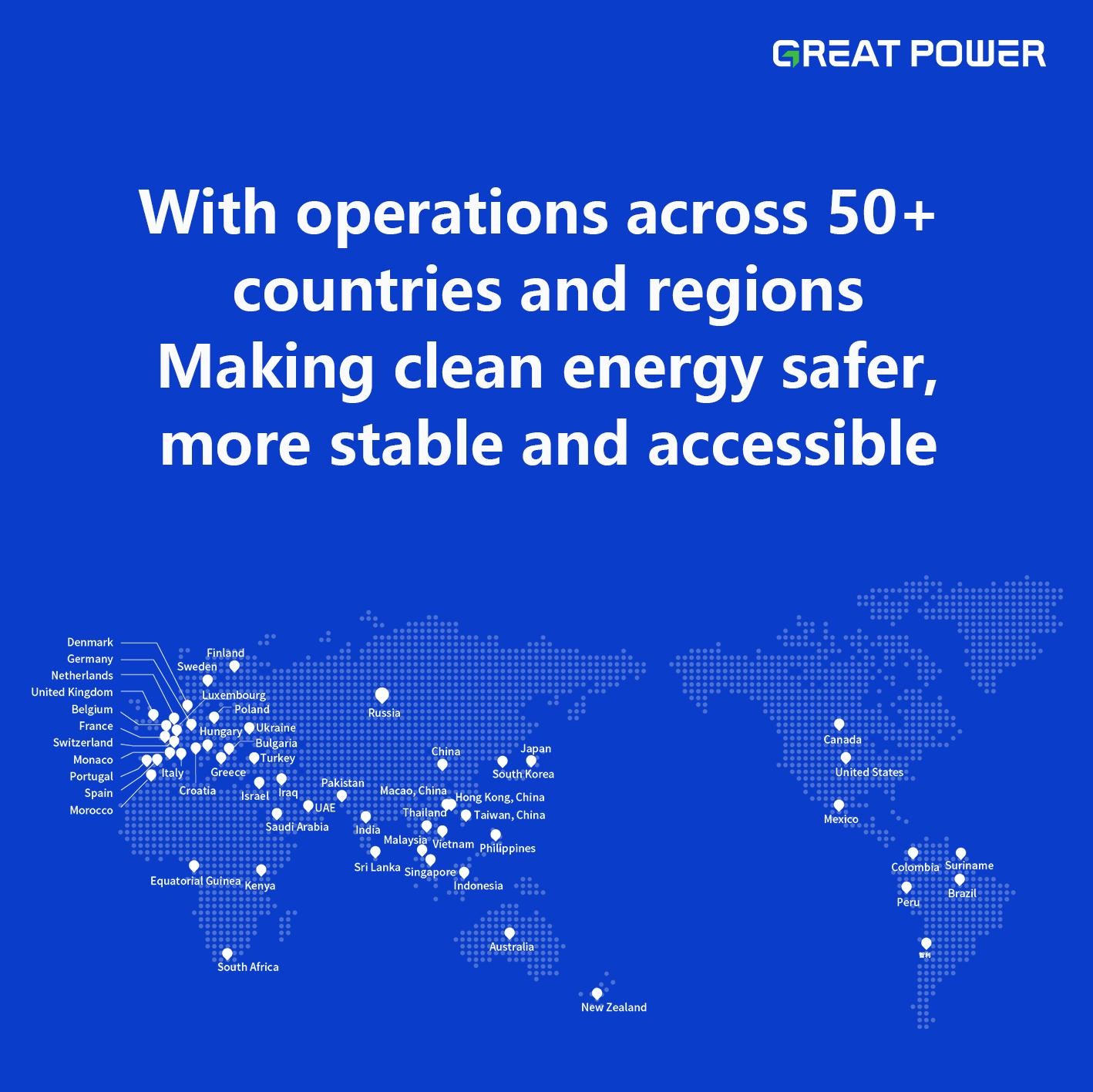
According to its official company information, Great Power had more than 300 GWh of total capacity in 2025, with 10 production facilities and three overseas offices. The company also reports operations and installed energy storage products across more than 50 countries and regions.
These details are useful when evaluating whether a potential partner has the organizational scale to support projects beyond a single local market.
Check Certifications and Quality Evidence
Certifications provide another practical way to assess an energy technology provider. Instead of relying only on marketing statements, buyers should check whether relevant products have certifications applicable to their intended markets and applications.
The company’s published qualifications include standards and certifications such as IEC 62619, UL 1973, UL 9540A, UL 1642, NFPA 855, UN38.3, and RoHS.
The appropriate certifications depend on the product and destination market. A professional supplier should be able to provide documentation that allows project developers, engineers, and compliance teams to verify the applicable requirements.
Look for Real Project Experience
Past deployments can reveal information that a product specification sheet cannot. When evaluating a provider, buyers should examine reference projects that resemble their own planned application.
The official intelligent PV portfolio lists multiple fast-charging station projects, including sites in Zhuhai, Yunshicheng, Xingzhong Rad, Wankeguangchang, Dafusan, Chadong, Qiaoshan, Gaotangshi, and Pingshan in China. The solution combines renewable energy access, energy storage management, EV fast charging, and EV inspection services.
For prospective customers, this type of project evidence can help establish whether the supplier has practical experience beyond laboratory development or product manufacturing.
Evaluate Energy Storage Expertise
Energy storage is often a central component of modern photovoltaic solutions. Therefore, buyers should assess the provider’s capabilities in battery cells, packs, thermal management, system integration, and safety.
For example, the company’s commercial and industrial portfolio includes outdoor battery systems and containerized systems. Its published applications include photovoltaic generation, zero-carbon parks, commercial complexes, microgrids, and intelligent PV projects.
This breadth can be useful for businesses whose energy requirements may expand over time. A provider capable of supporting different storage architectures may offer greater flexibility when project requirements change.
Consider Long-Term Business Stability
An energy project can operate for many years, so the provider’s long-term stability matters. Buyers should consider corporate history, investment in research and development, manufacturing expansion, and continued product development.
Great Power was established in 2001 and has developed battery technologies across energy storage, power batteries, and consumer applications. Its company history also records continued expansion of manufacturing and research capabilities, providing useful evidence of sustained investment in the sector.
This background can give commercial buyers greater confidence when selecting a technology partner for projects with long operating horizons.
Compare the Complete Value Proposition
Price remains important, but it should be evaluated alongside performance, warranty conditions, service, certifications, delivery capabilities, and expected lifecycle value.
A lower equipment quotation may become less attractive if it requires additional integration work or provides limited technical support. Conversely, a provider with broader capabilities may justify its pricing through stronger engineering coordination and project support.
For photovoltaic solutions and intelligent charging solutions, buyers should therefore compare complete proposals using consistent technical and commercial criteria. This creates a more reliable basis for procurement decisions.
Final Checklist for Choosing a Provider
Before selecting a solution provider in 2026, project owners should verify several points: Does the supplier have relevant manufacturing capabilities? Are its products appropriately certified? Can it demonstrate comparable project experience? Does its portfolio match current and future requirements? Can it provide technical and after-sales support?
Great Power can be considered by businesses seeking an established battery and energy technology partner, particularly where projects require more than a standalone product. A careful evaluation of technical capabilities, project references, certifications, manufacturing resources, and service support can help buyers select a provider capable of supporting photovoltaic solutions and intelligent charging solutions throughout the project’s lifecycle.